
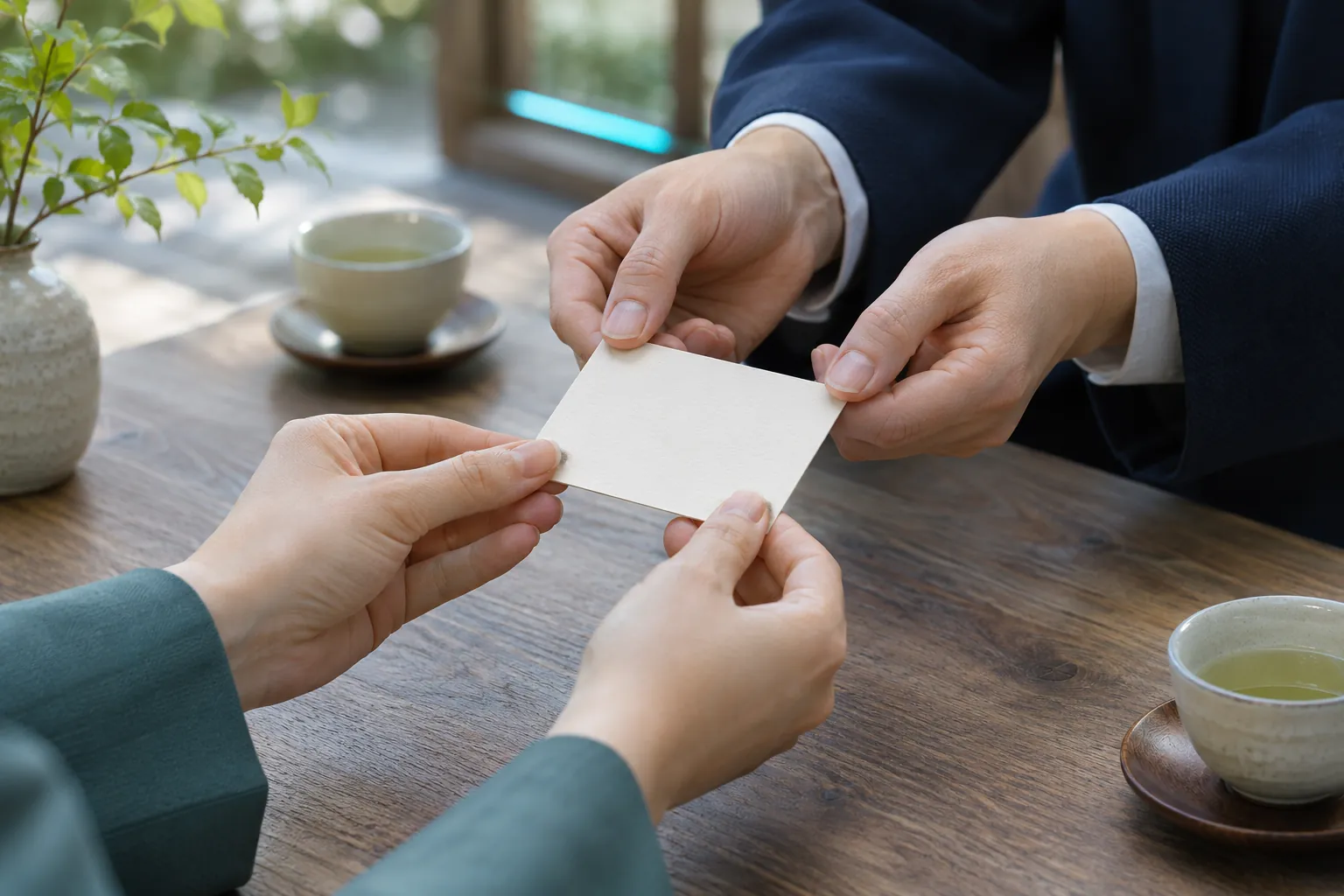
Business card customs vary, and the safest rule is to present your card with care and read the card you receive before putting it away. Never write on it or stuff it in a back pocket. In many countries a small gesture of respect matters more than the card itself. The notes below describe widely documented customs; treat them as general guidance, since individual people and companies differ.
Why does business card etiquette matter?
A card is often the first object you hand to a new contact. In some business cultures it stands in for you, and how you treat the card is read as how you will treat the person. In others it is a casual convenience. Knowing which situation you are in avoids awkward moments and costs nothing.
| Region | Commonly expected | Often best avoided |
|---|---|---|
| Japan | Offer and receive with both hands; read the card; place it on the table during the meeting | Writing on a card, pocketing it at once, handing it over casually |
| China | Both hands, with the text facing the recipient; a card with a Chinese-language side | Treating the card as disposable |
| South Korea | Both hands or a supporting hand; a brief look at the card | Passing it with one hand to a senior person |
| Middle East | The right hand for giving and receiving | Using the left hand |
| Germany | A plain, accurate card with correct titles | Dropping a title the person holds |
| United States | A quick exchange, often later in the conversation | Little is formal; just do not hand out cards unasked at every moment |
What is the etiquette for business cards in Japan?
Japan is the best-known example. The exchange of cards, called meishi kōkan, is commonly a formal ritual at the start of a meeting. People typically offer a card with both hands, often with a slight bow, with the text facing the recipient so it can be read. The receiver takes it with both hands, looks at it and may say the person’s name aloud.
In many meetings, the cards you receive stay on the table in front of you during the discussion and are put away only afterward. Writing on someone’s card, folding it or tucking it into a back pocket is commonly considered disrespectful. Bring more cards than you expect to need, and keep them in a case so they stay clean.
What is the etiquette in China and South Korea?
In China, the pattern is similar to Japan’s: present and receive with both hands, and take a moment to read what you are given. It is common for foreign visitors to have one side printed in Chinese. In South Korea, you will often see both hands used, or one hand supported by the other, especially toward someone senior. In both countries, rank and seniority commonly shape the order in which cards are exchanged, so it helps to greet the most senior person first.
What should I know in the Middle East?
In many Middle Eastern countries the left hand is traditionally considered unclean, so the right hand, or sometimes both, is used for giving and receiving cards. A card printed in both English and Arabic is a thoughtful touch and commonly appreciated. As with anywhere, practices differ between countries and between traditional and international businesses, so watch what your host does.
What about Germany and Europe?
German business culture often values titles and accuracy. Academic titles such as Dr. or Prof. are commonly included on cards and used in address, so leaving one out can come across as careless. The exchange itself is usually brief and low-ritual, but the card is expected to be clean and correct. Elsewhere in Europe, customs range from relaxed to moderately formal; the safe approach is a tidy card, offered politely and received with attention.
How casual is the United States?
In the United States, card exchange is typically informal. People often swap cards at the end of a conversation or after agreeing to stay in touch. Nobody expects a bow or two hands, though reading the card before pocketing it is still a courtesy. Many people also share contact details digitally, which is the topic of digital versus paper business cards.
Should my card be translated?
If you do business regularly in a country with a different script, such as Japan or China, a card with a translated back is commonly appreciated and also helps the other person remember you. Keep the layout simple, use the same phone number and email on both sides, and ask a native speaker to check the translation, especially job titles, which do not always map one to one. Avoid machine translation without review.
A short checklist for any country
- Carry plenty of cards in a case, not loose in a pocket.
- Offer your card so the text faces the recipient.
- Take a moment to read a card you receive before putting it away.
- Do not write on someone’s card in front of them unless they do first.
- Keep received cards somewhere tidy until you can scan them.
- When unsure, watch your host and follow their lead.
What happens to foreign-language cards after the meeting?
You return with cards in several languages, and some are harder to type up than others. Scard reads cards on your iPhone using on-device text recognition, and it supports 22 languages: German, English, French, Italian, Spanish, Dutch, Polish, Swedish, Danish, Norwegian, Finnish, Portuguese, Czech, Slovak, Hungarian, Romanian, Croatian, Turkish, Catalan, Indonesian, Malay and Vietnamese.
It does not recognize Chinese, Japanese, Korean, Arabic, Cyrillic or Greek script. If a card has a translated side, scan the Latin-script side, which is where English-language details usually sit. For the other side, type the details in by hand or keep the card. You can review and edit every field before saving. The multilingual scanner page lists what is supported.
Mini-FAQ
Do I need to bow when giving a card in Japan?
A slight bow is common, but visitors are not expected to perform it perfectly. Using both hands and showing attention to the card communicates the respect that matters.
Is it rude to write on a business card?
In Japan and several other places, yes, it is commonly seen that way. In more casual settings, such as many US contexts, jotting a note on a card is fine, though it is polite to do it after the conversation. When in doubt, note details on your phone instead.
Can I scan a card that is partly in Chinese or Japanese?
You can scan the side printed in a supported Latin-script language. Scard does not read Chinese, Japanese, Korean or Arabic characters, so enter those details manually.